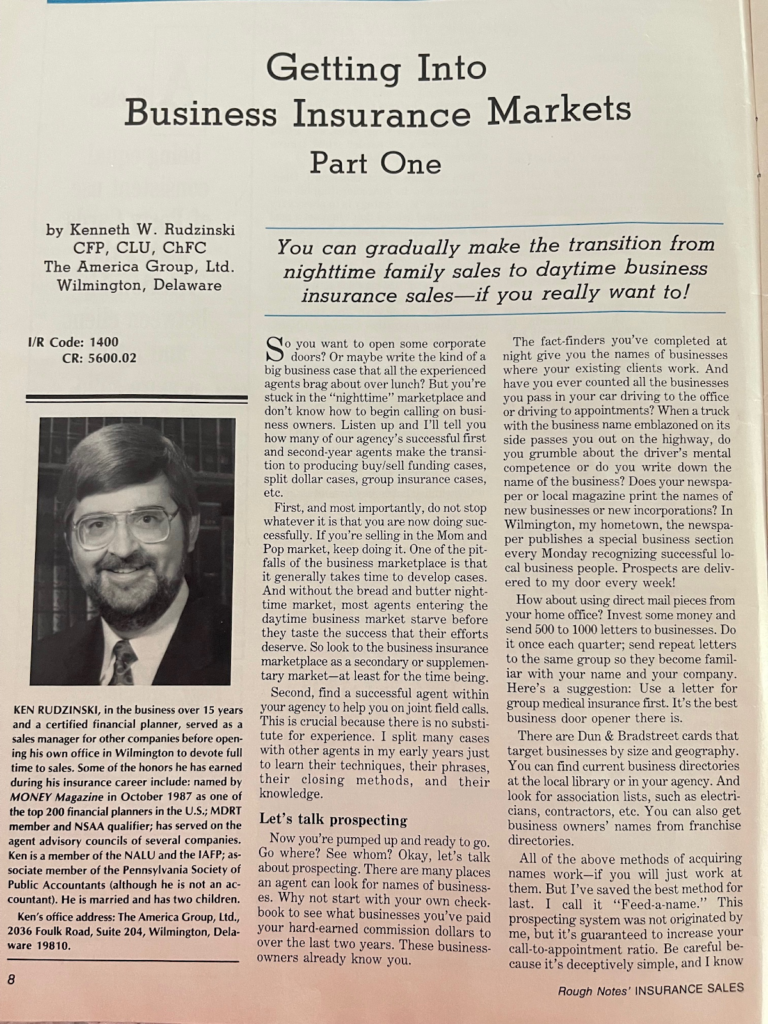
When I think back to my early years in the insurance business, one lesson stands out above all else: success comes from preparation, persistence, and learning from others. I began my career in the financial services industry in 1973 with Lincoln National Sales Corp., and eventually opened my own practice, The America Group, in Wilmington, Delaware. Over the years, I discovered that transitioning from family-oriented sales to the business insurance market required focus, strategy, and a willingness to learn.
Starting Where You Are
Many agents, when considering moving into the business insurance market, make the mistake of trying to start fresh. My advice is simple: do not stop what is already working. If you are successful selling to the Mom-and-Pop market, continue doing so. This “bread and butter” market is essential because it allows you to keep generating business while learning the nuances of corporate clients. Without a strong base, agents often struggle when entering the daytime business market. The key is to view business insurance as a supplement or secondary market at first, gradually building expertise and confidence.
Learning From Experienced Agents
One of the most important steps I took in my early career was seeking guidance from successful agents within my agency. Partnering with someone who already had experience in business insurance allowed me to learn techniques, closing methods, and phrases that worked in the corporate market. Shadowing and splitting cases with experienced agents was invaluable. Not only did it teach me technical skills, but it also built confidence to approach business owners and present solutions effectively.
There is no substitute for experience. Watching and learning from others helped me develop the judgment needed to evaluate businesses, understand their unique needs, and design policies that fit their goals. I often encourage new agents to embrace mentorship because it accelerates the learning curve in a way that self-study cannot.
Prospecting With Purpose
Once you have a foundation, the next step is prospecting. Prospecting is where preparation meets action. In my early years, I used every available resource to identify businesses that could benefit from insurance coverage. I reviewed my own client records, keeping track of businesses my family clients worked with. I observed companies during my daily routines, noting new business signage and companies mentioned in newspapers or local publications.
Direct mail can also be a useful tool. I often sent letters from my home office to introduce my services to businesses, focusing on group medical insurance as an entry point. Sending repeat letters to the same group of businesses helped establish familiarity and trust with potential clients. Prospecting is a consistent effort; it is not a one-time activity. The key is to stay organized, track responses, and follow up.
Using All Available Resources
Over the years, I learned that successful agents use a combination of resources to find leads. Business directories, such as Dun & Bradstreet or local association lists, provide names of potential clients organized by size and geography. Franchise directories also offer valuable insights into companies looking for comprehensive coverage. The most effective method I discovered was something I call “Feed-a-name.” This approach involves tracking the businesses you already know, such as those you have serviced in other capacities, and systematically reaching out to them. It may not be the flashiest method, but it guarantees a higher call-to-appointment ratio because you are contacting businesses that are already familiar with your name and your reputation.
The Importance of Strategy
Transitioning into the business insurance market requires more than just prospecting. It demands a strategic mindset. Each client is unique, with different risks, goals, and resources. A thoughtful agent evaluates each situation, designs tailored solutions, and communicates the value of their services clearly. In my experience, business owners respond positively when they feel understood and supported rather than pressured. Strategy involves careful observation, research, and planning before making the first contact.
Persistence Pays Off
The reality of business insurance sales is that success rarely comes overnight. Many agents struggle at first because the market takes time to develop. The businesses you approach may not be ready to commit immediately, and building relationships can take months. Persistence is essential. By maintaining consistent contact, learning from each interaction, and refining your approach, agents can achieve sustainable success.
Reflections on My Career
Looking back, I realize how much my early experiences shaped my approach to financial planning and insurance. I learned that preparation, mentorship, strategy, and persistence are the keys to long-term success. Those lessons helped me serve clients across Southeastern Pennsylvania, Delaware, South Jersey, and Northeastern Maryland, building a national practice while remaining committed to high-quality service.
I also learned the importance of giving back. Just as I benefited from guidance and mentoring early in my career, I have always tried to help younger agents and clients navigate the complex world of insurance, investments, and financial planning. Sharing knowledge and experience strengthens relationships and builds trust, which is invaluable in this industry.
Entering the business insurance market may seem daunting at first, but it is entirely achievable with the right approach. Start where you are, learn from experienced agents, prospect with purpose, and stay persistent. Use every tool available, and do not be afraid to ask for guidance along the way. The combination of strategy, mentorship, and determination will help any agent succeed.
Reflecting on my own journey, I realize that success in this field is not just about closing cases or earning commissions. It is about helping businesses protect their future, building lasting relationships, and growing as a professional. These principles guided me throughout my career and continue to influence the way I approach financial planning and client service to this day.